Personalization

Shopify Personalization App Comparison: How to Choose (2026)

Shopify Personalization App Comparison: How to Choose (2026)

Choosing a personalization app for Shopify is harder than it should be. The category is crowded, the marketing is interchangeable, and most comparison articles lump three completely different kinds of software into one list without telling you which is which.

This guide breaks down the six apps actually worth evaluating in 2026. For each one: what it does, where it falls short, and the kind of store it fits. The goal is to get you to a shortlist of two or three in the time it takes to drink a coffee, rather than the afternoon most merchants spend wading through vendor pages.

"Personalization" on Shopify means three different things

One of the problems when reading typical comparisons is that personalization means different things to different people:

  1. Content and experience personalization
    Different shoppers see different hero banners, headlines, layouts, sections, and offers based on where they came from or who they are. This is what Relevant Bits, Visually, Fermat, Dialogue, and part of Nosto do.

  2. Product recommendation engines
    AI-ranked product grids, “Customers also bought,” “recommended for you,” and related items on PDPs. This is what Rebuy and LimeSpot primarily do, and what the other part of Nosto does.

  3. Product customization
    Letting a shopper design their own version of a product: engrave a name, change a color, or upload an image. This is what Customily, Kickflip, and Inkybay do. Different category entirely. Not covered here.

This comparison covers category one, because that is where the real strategic decision lives for most Plus and larger stores. Recommendation engines get a brief note at the end for brands that need both.

A storefront that serves the same hero banner to a VIP Klaviyo subscriber and a cold Meta click is leaving money on the table. The tools below exist to fix that gap.

Why Shopify personalization is its own category

Generic personalization platforms were not designed for Shopify. They were built for WordPress, custom React stacks, and enterprise CMS systems, and then ported over. The port usually shows.

A few specifics worth knowing before you evaluate anything:

  • Shopify stores render from Liquid, JSON templates, and theme sections. Any tool that lives outside that system has to work around it, usually by injecting JavaScript into the page after it starts loading.
  • That injection causes flickering, the flash of the original content before the variant loads, plus page speed hits and layout shift. On mobile, it is particularly noticeable.
  • Shopify's native capabilities — Markets, customer segments, metaobjects — are either invisible to third-party tools or poorly integrated. That matters a lot if you are running multi-region merchandising.
  • Checkout is locked down. Anything that personalizes checkout needs Shopify Plus and Checkout Extensibility, and most tools on this list do not actually touch checkout in a meaningful way.

For Plus stores in particular, the architecture question is not a detail. The tool that ships personalized content before the page renders is a fundamentally different product from the one that paints over the original hero two hundred milliseconds later.

What to actually look at when comparing

A checklist you can steal (because you don't know what you don't know)

  1. Integration depth: Native to Shopify's theme editor and native sections, or a parallel editor?
  2. Performance impact: Flicker, CLS, and page-speed cost. Ask for real data, not a spec sheet.
  3. Scope of what you can personalize: Sections, banners, product grids, pricing, checkout, email, or all of the above.
  4. Available targeting signals: UTM, referrer, location, Klaviyo segments, login status, cart state, time zone, Shopify Markets, product tags, and weather. The question is not how many, but whether the ones you need are supported.
  5. Design preservation: Does the tool use your existing theme, or replace parts of it?
  6. A/B testing as a first-class feature: Personalization without testing is a slower form of guessing.
  7. Pricing model: Flat, traffic-based, or custom. Model what your bill looks like at 2x your current traffic.
  8. Support and implementation: Self-serve versus managed. Both are legitimate; they suit different teams.

The six apps worth considering

Nosto
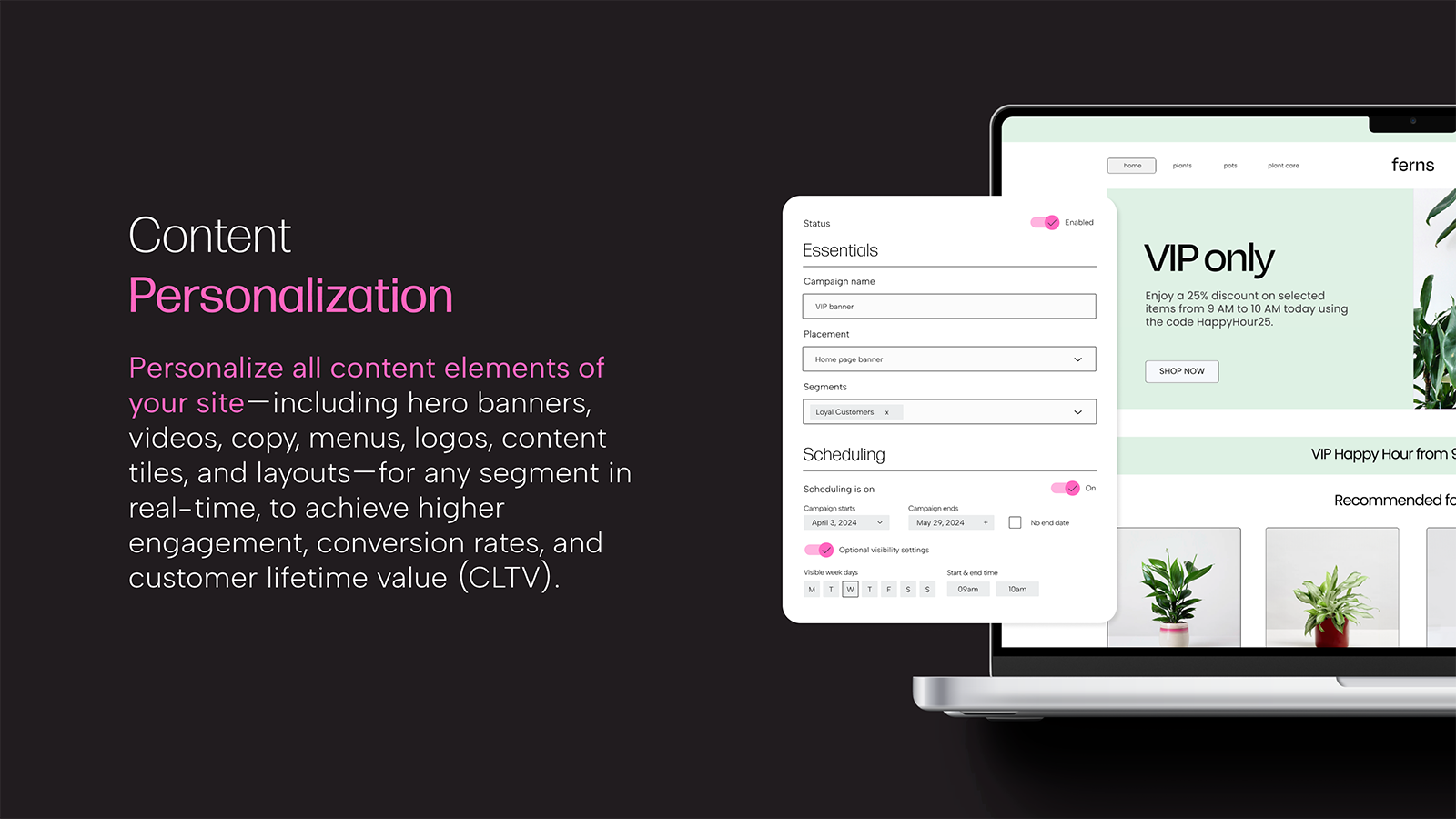
Content Personalization

Nosto is the incumbent. It is a Shopify Plus Certified App Partner, positioned at enterprise brands, and offers a full Commerce Experience Platform covering AI search, product recommendations, merchandising, content personalization, and A/B testing in one suite. If you want one vendor running your entire discovery layer and you have the budget for it, Nosto is the obvious first look.

Where it works: brands doing meaningful revenue that want to consolidate search, recommendations, merchandising, and content personalization under a single contract.

Where it falls short: pricing is custom and usually lands in five figures annually. Implementation is measured in weeks, not days. For stores that specifically want content and experience personalization inside their theme, Nosto is bigger than the problem you are trying to solve. You are buying search and merchandising you may not need.

Typical fit: Shopify Plus brands doing $10M and up, with in-house CRO and budget for a managed platform.

Relevant Bits

Turn visitors into buyers with tailored shopping experiences

Relevant Bits is designed for Shopify Plus and established brands that want personalization inside their existing stack rather than bolted on top of it. The app is Built for Shopify certified, which means it has met Shopify's highest bar for performance, design, and integration. It works entirely inside the native Shopify theme editor. You personalize the sections you already use, with the designers and freelancers you already work with.

The rule library covers the signals Plus teams actually reach for: geographic location, UTM parameters, domain referrer, customer segments (both Shopify and Klaviyo, with two-way Klaviyo sync), Shopify Markets, login status, cart products, cart count, cart value, product tags, date range and time, time zone, time of day, and weather. Variations are created in the theme editor with your existing components, which means a recipe for a summer promo in Germany does not require a separate template or a developer. A/B testing is built into every recipe natively.

The architecture is where the magic happens. Relevant Bits renders variations using your existing theme sections and the native Shopify theme editor, with no third-party editor and no code injection required. The result: zero flickering and content delivery in under fifteen milliseconds. For Plus brands that have spent money on a theme they actually like, that matters.

Where it falls short: if your primary need is AI-ranked product recommendations on PDPs, a “customers also bought” engine, Relevant Bits is not the right tool. That is a different category of software. A subset of brands run Relevant Bits alongside a recommendations engine for exactly this reason.

Typical fit: Shopify Plus and larger stores that run paid media, manage multiple markets or audiences, and want personalization to live natively in the theme editor rather than in a parallel tool.

Most personalization tools ask you to abandon your theme and rebuild in their editor. Relevant Bits is the opposite bet. Your theme is already good. Personalize what is already there.

Visually.io


Visually positions itself as a full-funnel optimization platform: A/B testing, personalization, product recommendations, upsells, post-purchase. One vendor for most of the CRO stack. It uses its own visual editor that layers on top of your store, and its marketing leans heavily on AI-generated test variants.

Where it works: brands that want velocity on both testing and personalization from a single tool, and are comfortable doing that work inside a third-party editor rather than Shopify's.

Where it falls short: the “one tool for everything” pitch comes with the usual trade-offs. The editor lives outside Shopify's native rendering, which means the architectural concerns at the top of this piece apply: client-side injection, potential for flicker, and the weight of another JavaScript layer on every page.

Typical fit: mid-market to Plus brands running high-velocity testing and personalization programs who prefer a consolidated suite.

Fermat

Fermat is the purest “landing pages for paid traffic” play in the group. It is built around the idea that every paid campaign deserves its own post-click experience, and it is designed to produce those experiences at scale without touching your core theme.

Where it works: DTC brands with serious Meta and Google spend where the performance team needs its own canvas separate from the main site. For paid traffic specifically, Fermat is the deepest tool on this list.

Where it falls short: Fermat is not a general site personalization tool. If you want different content for logged-in customers, Klaviyo VIPs, or returning shoppers on your homepage and collections, Fermat is not the shape for that. The value is concentrated in paid post-click flows.

Typical fit: brands spending $250K+ per month on paid media with dedicated performance teams.

Dynamic Yield

Dynamic Yield is Mastercard-owned, enterprise-grade, and sold to enterprise buyers. Per StoreInspect's 232K-store study, all of Dynamic Yield's roughly fifty detected Shopify installs are on Shopify Plus stores, with the majority in the 200K to 1M monthly visitor tier.

Where it works: cross-channel personalization with advanced AI decisioning for brands that need it and can operate it.

Where it falls short: price and complexity. Annual contracts start in the five figures and run much higher. Implementations require internal engineering. For 99% of Shopify merchants, this is more platform than you need.

Typical fit: enterprise brands doing $50M+ with dedicated CRO teams and a budget that treats personalization as infrastructure.

Dialogue

Dialogue is a visual commerce play. Shoppable Reels, Storyteller modules, video-first product discovery layered with behavioral segmentation. It is a real product with real customers, but the shape of it is specific: it is about turning the storefront into a content experience, not about matching audiences to what they see on your site.

Where it works: fashion, beauty, and lifestyle brands whose differentiation is visual content and who want that content to be natively shoppable.

Where it falls short: if your personalization problem is strategic — different offers to different audiences, Klaviyo-driven segmentation, paid-to-site matching — Dialogue is not a natural fit. The visual-commerce framing is the product.

Typical fit: content-heavy DTC brands in visual-first categories.

One note on product recommendations

Rebuy and LimeSpot are the two most installed dedicated recommendation apps among Shopify stores personalizing their storefront, per StoreInspect's 232K-store study. They are not really in the same category as the tools above. They decide which products to show. The tools above decide what messaging, layout, and offer to wrap around those products.

A non-trivial number of Plus brands run a recommendations engine and a content personalization tool side by side for exactly this reason. You do not have to pick.

Quick comparison

Tool Works inside Shopify theme editor Built-in A/B testing Shopify Plus focus Entry price
Nosto No (external platform) Yes Plus Certified, enterprise Custom
Relevant Bits Yes Yes Built for Shopify Plus and larger stores $99/mo
Visually No (external editor) Yes Mid-market to Plus $15/mo for under 100 orders
Fermat No (external platform) Yes (post-click) Paid-heavy DTC Custom
Dynamic Yield No (external platform) Yes Enterprise only Custom
Dialogue No (external platform) Check vendor Visual-first DTC Check vendor

Pricing was deliberately kept light. Four of these six use custom pricing that moves with traffic, contract length, and negotiation. The only number that matters is a real quote for your store.

Which tool fits which situation

Shortcut version. Start with the use case, not the tool.

  1. You are a Shopify Plus brand that wants personalization to live inside your existing theme and native stack. Relevant Bits. This is exactly what the product is designed for.
  2. You run paid ads and want landing pages to match ad creative. Relevant Bits covers this cleanly if you are personalizing existing theme sections by UTM. Fermat is the right call if you are launching dozens of post-click experiences per campaign and need a dedicated paid-media canvas.
  3. You want to personalize content by Klaviyo segment, with engagement data flowing back. Relevant Bits has native two-way Klaviyo sync and is the most direct fit in the category.
  4. You sell in multiple Shopify Markets and need country-specific merchandising. Relevant Bits on the Growth plan is the most Shopify-native way to do this. Nosto is the enterprise-grade alternative if you are already running their platform.
  5. You are a Plus brand that wants search, merchandising, recommendations, and content personalization under one contract. Nosto is the clear answer.
  6. You want AI-ranked product recommendations on your PDPs. Rebuy or LimeSpot. Run them alongside whatever content personalization tool you choose.
  7. You are an enterprise with internal engineering resources and cross-channel personalization needs. Dynamic Yield or Nosto.
  8. Your storefront differentiation is video and creator content. Dialogue.
  9. You are doing serious CRO velocity and want testing and personalization under one vendor, and you are fine living outside the Shopify theme editor. Visually is worth a look.

For the majority of Plus and larger brands that land on this article, the decision comes down to two or three of these, not nine. If you are personalizing content in your theme, evaluating Relevant Bits against Nosto is usually the shortest path.

What to do next

Start with the question, not the vendor. Write down the three audience splits that actually matter to your revenue: the paid traffic segment, the VIP Klaviyo segment, the underperforming market. Then look at which tool above makes those three splits easy. The rest of the feature matrix gets easier from there.

If Relevant Bits looks like the right shape, the fourteen-day free trial is the cheapest way to find out. Install it, build one recipe, and see whether the architecture holds up to what this article promised.

FAQ

What is the best Shopify personalization app?

There is no single answer, because "personalization" covers three different product categories. For content and experience personalization inside the Shopify theme editor, Relevant Bits is purpose-built for that workflow. For enterprise brands running an end-to-end commerce experience platform with search and merchandising included, Nosto is the incumbent.

Does Shopify have built-in personalization?

Shopify offers basic product recommendations through its free Search & Discovery app and native "related products" blocks. For anything beyond that — UTM-based content, Klaviyo-segment targeting, geographic variations, or A/B testing on theme sections — you need a third-party app.

How much do Shopify personalization apps cost?

Pricing ranges widely. Relevant Bits starts at $99 per month. Most enterprise platforms (Nosto, Dynamic Yield, Fermat) use custom pricing that typically lands in five figures annually. Per StoreInspect's adoption data, the cost barrier is one of the main reasons only 2.5% of Shopify stores run a personalization app at all.

Can you run more than one personalization app at the same time?

Yes, and a meaningful number of Plus brands do. The most common pairing is a content personalization tool (for hero banners, section swaps, and audience targeting) alongside a product recommendation engine (for "customers also bought" grids on PDPs and in the cart). These solve different problems and tend to complement each other rather than conflict.

Does a Shopify personalization app slow down your store?

It depends entirely on how the app is built. Tools that inject JavaScript after the page starts loading can cause flickering, layout shift, and page-speed hits on mobile. Apps that render variations inside the native Shopify theme editor — like Relevant Bits — avoid the flicker because the right variant is served before the page renders. When evaluating any app, ask the vendor for real Core Web Vitals data from a production install, not a marketing spec sheet.

Reading next

Geographic Personalization For Shopify: Complete Implementation Guide

Leave a comment

This site is protected by hCaptcha and the hCaptcha Privacy Policy and Terms of Service apply.

Personalization
Apr 23, 2026 · 12 min read

Shopify Personalization App Comparison: How to Choose (2026)

M
Mark Dodgson
Shopify Personalization App Comparison: How to Choose (2026)

Choosing a personalization app for Shopify is harder than it should be. The category is crowded, the marketing is interchangeable, and most comparison articles lump three completely different kinds of software into one list without telling you which is which.

This guide breaks down the six apps actually worth evaluating in 2026. For each one: what it does, where it falls short, and the kind of store it fits. The goal is to get you to a shortlist of two or three in the time it takes to drink a coffee, rather than the afternoon most merchants spend wading through vendor pages.

"Personalization" on Shopify means three different things

One of the problems when reading typical comparisons is that personalization means different things to different people:

  1. Content and experience personalization
    Different shoppers see different hero banners, headlines, layouts, sections, and offers based on where they came from or who they are. This is what Relevant Bits, Visually, Fermat, Dialogue, and part of Nosto do.

  2. Product recommendation engines
    AI-ranked product grids, “Customers also bought,” “recommended for you,” and related items on PDPs. This is what Rebuy and LimeSpot primarily do, and what the other part of Nosto does.

  3. Product customization
    Letting a shopper design their own version of a product: engrave a name, change a color, or upload an image. This is what Customily, Kickflip, and Inkybay do. Different category entirely. Not covered here.

This comparison covers category one, because that is where the real strategic decision lives for most Plus and larger stores. Recommendation engines get a brief note at the end for brands that need both.

A storefront that serves the same hero banner to a VIP Klaviyo subscriber and a cold Meta click is leaving money on the table. The tools below exist to fix that gap.

Why Shopify personalization is its own category

Generic personalization platforms were not designed for Shopify. They were built for WordPress, custom React stacks, and enterprise CMS systems, and then ported over. The port usually shows.

A few specifics worth knowing before you evaluate anything:

  • Shopify stores render from Liquid, JSON templates, and theme sections. Any tool that lives outside that system has to work around it, usually by injecting JavaScript into the page after it starts loading.
  • That injection causes flickering, the flash of the original content before the variant loads, plus page speed hits and layout shift. On mobile, it is particularly noticeable.
  • Shopify's native capabilities — Markets, customer segments, metaobjects — are either invisible to third-party tools or poorly integrated. That matters a lot if you are running multi-region merchandising.
  • Checkout is locked down. Anything that personalizes checkout needs Shopify Plus and Checkout Extensibility, and most tools on this list do not actually touch checkout in a meaningful way.

For Plus stores in particular, the architecture question is not a detail. The tool that ships personalized content before the page renders is a fundamentally different product from the one that paints over the original hero two hundred milliseconds later.

What to actually look at when comparing

A checklist you can steal (because you don't know what you don't know)

  1. Integration depth: Native to Shopify's theme editor and native sections, or a parallel editor?
  2. Performance impact: Flicker, CLS, and page-speed cost. Ask for real data, not a spec sheet.
  3. Scope of what you can personalize: Sections, banners, product grids, pricing, checkout, email, or all of the above.
  4. Available targeting signals: UTM, referrer, location, Klaviyo segments, login status, cart state, time zone, Shopify Markets, product tags, and weather. The question is not how many, but whether the ones you need are supported.
  5. Design preservation: Does the tool use your existing theme, or replace parts of it?
  6. A/B testing as a first-class feature: Personalization without testing is a slower form of guessing.
  7. Pricing model: Flat, traffic-based, or custom. Model what your bill looks like at 2x your current traffic.
  8. Support and implementation: Self-serve versus managed. Both are legitimate; they suit different teams.

The six apps worth considering

Nosto

Content Personalization

Nosto is the incumbent. It is a Shopify Plus Certified App Partner, positioned at enterprise brands, and offers a full Commerce Experience Platform covering AI search, product recommendations, merchandising, content personalization, and A/B testing in one suite. If you want one vendor running your entire discovery layer and you have the budget for it, Nosto is the obvious first look.

Where it works: brands doing meaningful revenue that want to consolidate search, recommendations, merchandising, and content personalization under a single contract.

Where it falls short: pricing is custom and usually lands in five figures annually. Implementation is measured in weeks, not days. For stores that specifically want content and experience personalization inside their theme, Nosto is bigger than the problem you are trying to solve. You are buying search and merchandising you may not need.

Typical fit: Shopify Plus brands doing $10M and up, with in-house CRO and budget for a managed platform.

Relevant Bits

Turn visitors into buyers with tailored shopping experiences

Relevant Bits is designed for Shopify Plus and established brands that want personalization inside their existing stack rather than bolted on top of it. The app is Built for Shopify certified, which means it has met Shopify's highest bar for performance, design, and integration. It works entirely inside the native Shopify theme editor. You personalize the sections you already use, with the designers and freelancers you already work with.

The rule library covers the signals Plus teams actually reach for: geographic location, UTM parameters, domain referrer, customer segments (both Shopify and Klaviyo, with two-way Klaviyo sync), Shopify Markets, login status, cart products, cart count, cart value, product tags, date range and time, time zone, time of day, and weather. Variations are created in the theme editor with your existing components, which means a recipe for a summer promo in Germany does not require a separate template or a developer. A/B testing is built into every recipe natively.

The architecture is where the magic happens. Relevant Bits renders variations using your existing theme sections and the native Shopify theme editor, with no third-party editor and no code injection required. The result: zero flickering and content delivery in under fifteen milliseconds. For Plus brands that have spent money on a theme they actually like, that matters.

Where it falls short: if your primary need is AI-ranked product recommendations on PDPs, a “customers also bought” engine, Relevant Bits is not the right tool. That is a different category of software. A subset of brands run Relevant Bits alongside a recommendations engine for exactly this reason.

Typical fit: Shopify Plus and larger stores that run paid media, manage multiple markets or audiences, and want personalization to live natively in the theme editor rather than in a parallel tool.

Most personalization tools ask you to abandon your theme and rebuild in their editor. Relevant Bits is the opposite bet. Your theme is already good. Personalize what is already there.

Visually.io


Visually positions itself as a full-funnel optimization platform: A/B testing, personalization, product recommendations, upsells, post-purchase. One vendor for most of the CRO stack. It uses its own visual editor that layers on top of your store, and its marketing leans heavily on AI-generated test variants.

Where it works: brands that want velocity on both testing and personalization from a single tool, and are comfortable doing that work inside a third-party editor rather than Shopify's.

Where it falls short: the “one tool for everything” pitch comes with the usual trade-offs. The editor lives outside Shopify's native rendering, which means the architectural concerns at the top of this piece apply: client-side injection, potential for flicker, and the weight of another JavaScript layer on every page.

Typical fit: mid-market to Plus brands running high-velocity testing and personalization programs who prefer a consolidated suite.

Fermat

Fermat is the purest “landing pages for paid traffic” play in the group. It is built around the idea that every paid campaign deserves its own post-click experience, and it is designed to produce those experiences at scale without touching your core theme.

Where it works: DTC brands with serious Meta and Google spend where the performance team needs its own canvas separate from the main site. For paid traffic specifically, Fermat is the deepest tool on this list.

Where it falls short: Fermat is not a general site personalization tool. If you want different content for logged-in customers, Klaviyo VIPs, or returning shoppers on your homepage and collections, Fermat is not the shape for that. The value is concentrated in paid post-click flows.

Typical fit: brands spending $250K+ per month on paid media with dedicated performance teams.

Dynamic Yield

Dynamic Yield is Mastercard-owned, enterprise-grade, and sold to enterprise buyers. Per StoreInspect's 232K-store study, all of Dynamic Yield's roughly fifty detected Shopify installs are on Shopify Plus stores, with the majority in the 200K to 1M monthly visitor tier.

Where it works: cross-channel personalization with advanced AI decisioning for brands that need it and can operate it.

Where it falls short: price and complexity. Annual contracts start in the five figures and run much higher. Implementations require internal engineering. For 99% of Shopify merchants, this is more platform than you need.

Typical fit: enterprise brands doing $50M+ with dedicated CRO teams and a budget that treats personalization as infrastructure.

Dialogue

Dialogue is a visual commerce play. Shoppable Reels, Storyteller modules, video-first product discovery layered with behavioral segmentation. It is a real product with real customers, but the shape of it is specific: it is about turning the storefront into a content experience, not about matching audiences to what they see on your site.

Where it works: fashion, beauty, and lifestyle brands whose differentiation is visual content and who want that content to be natively shoppable.

Where it falls short: if your personalization problem is strategic — different offers to different audiences, Klaviyo-driven segmentation, paid-to-site matching — Dialogue is not a natural fit. The visual-commerce framing is the product.

Typical fit: content-heavy DTC brands in visual-first categories.

One note on product recommendations

Rebuy and LimeSpot are the two most installed dedicated recommendation apps among Shopify stores personalizing their storefront, per StoreInspect's 232K-store study. They are not really in the same category as the tools above. They decide which products to show. The tools above decide what messaging, layout, and offer to wrap around those products.

A non-trivial number of Plus brands run a recommendations engine and a content personalization tool side by side for exactly this reason. You do not have to pick.

Quick comparison

Tool Works inside Shopify theme editor Built-in A/B testing Shopify Plus focus Entry price
Nosto No (external platform) Yes Plus Certified, enterprise Custom
Relevant Bits Yes Yes Built for Shopify Plus and larger stores $99/mo
Visually No (external editor) Yes Mid-market to Plus $15/mo for under 100 orders
Fermat No (external platform) Yes (post-click) Paid-heavy DTC Custom
Dynamic Yield No (external platform) Yes Enterprise only Custom
Dialogue No (external platform) Check vendor Visual-first DTC Check vendor

Pricing was deliberately kept light. Four of these six use custom pricing that moves with traffic, contract length, and negotiation. The only number that matters is a real quote for your store.

Which tool fits which situation

Shortcut version. Start with the use case, not the tool.

  1. You are a Shopify Plus brand that wants personalization to live inside your existing theme and native stack. Relevant Bits. This is exactly what the product is designed for.
  2. You run paid ads and want landing pages to match ad creative. Relevant Bits covers this cleanly if you are personalizing existing theme sections by UTM. Fermat is the right call if you are launching dozens of post-click experiences per campaign and need a dedicated paid-media canvas.
  3. You want to personalize content by Klaviyo segment, with engagement data flowing back. Relevant Bits has native two-way Klaviyo sync and is the most direct fit in the category.
  4. You sell in multiple Shopify Markets and need country-specific merchandising. Relevant Bits on the Growth plan is the most Shopify-native way to do this. Nosto is the enterprise-grade alternative if you are already running their platform.
  5. You are a Plus brand that wants search, merchandising, recommendations, and content personalization under one contract. Nosto is the clear answer.
  6. You want AI-ranked product recommendations on your PDPs. Rebuy or LimeSpot. Run them alongside whatever content personalization tool you choose.
  7. You are an enterprise with internal engineering resources and cross-channel personalization needs. Dynamic Yield or Nosto.
  8. Your storefront differentiation is video and creator content. Dialogue.
  9. You are doing serious CRO velocity and want testing and personalization under one vendor, and you are fine living outside the Shopify theme editor. Visually is worth a look.

For the majority of Plus and larger brands that land on this article, the decision comes down to two or three of these, not nine. If you are personalizing content in your theme, evaluating Relevant Bits against Nosto is usually the shortest path.

What to do next

Start with the question, not the vendor. Write down the three audience splits that actually matter to your revenue: the paid traffic segment, the VIP Klaviyo segment, the underperforming market. Then look at which tool above makes those three splits easy. The rest of the feature matrix gets easier from there.

If Relevant Bits looks like the right shape, the fourteen-day free trial is the cheapest way to find out. Install it, build one recipe, and see whether the architecture holds up to what this article promised.

FAQ

What is the best Shopify personalization app?

There is no single answer, because "personalization" covers three different product categories. For content and experience personalization inside the Shopify theme editor, Relevant Bits is purpose-built for that workflow. For enterprise brands running an end-to-end commerce experience platform with search and merchandising included, Nosto is the incumbent.

Does Shopify have built-in personalization?

Shopify offers basic product recommendations through its free Search & Discovery app and native "related products" blocks. For anything beyond that — UTM-based content, Klaviyo-segment targeting, geographic variations, or A/B testing on theme sections — you need a third-party app.

How much do Shopify personalization apps cost?

Pricing ranges widely. Relevant Bits starts at $99 per month. Most enterprise platforms (Nosto, Dynamic Yield, Fermat) use custom pricing that typically lands in five figures annually. Per StoreInspect's adoption data, the cost barrier is one of the main reasons only 2.5% of Shopify stores run a personalization app at all.

Can you run more than one personalization app at the same time?

Yes, and a meaningful number of Plus brands do. The most common pairing is a content personalization tool (for hero banners, section swaps, and audience targeting) alongside a product recommendation engine (for "customers also bought" grids on PDPs and in the cart). These solve different problems and tend to complement each other rather than conflict.

Does a Shopify personalization app slow down your store?

It depends entirely on how the app is built. Tools that inject JavaScript after the page starts loading can cause flickering, layout shift, and page-speed hits on mobile. Apps that render variations inside the native Shopify theme editor — like Relevant Bits — avoid the flicker because the right variant is served before the page renders. When evaluating any app, ask the vendor for real Core Web Vitals data from a production install, not a marketing spec sheet.

Show every visitor the right store

Personalize your Shopify storefront in minutes. No code required.

Start your free trial